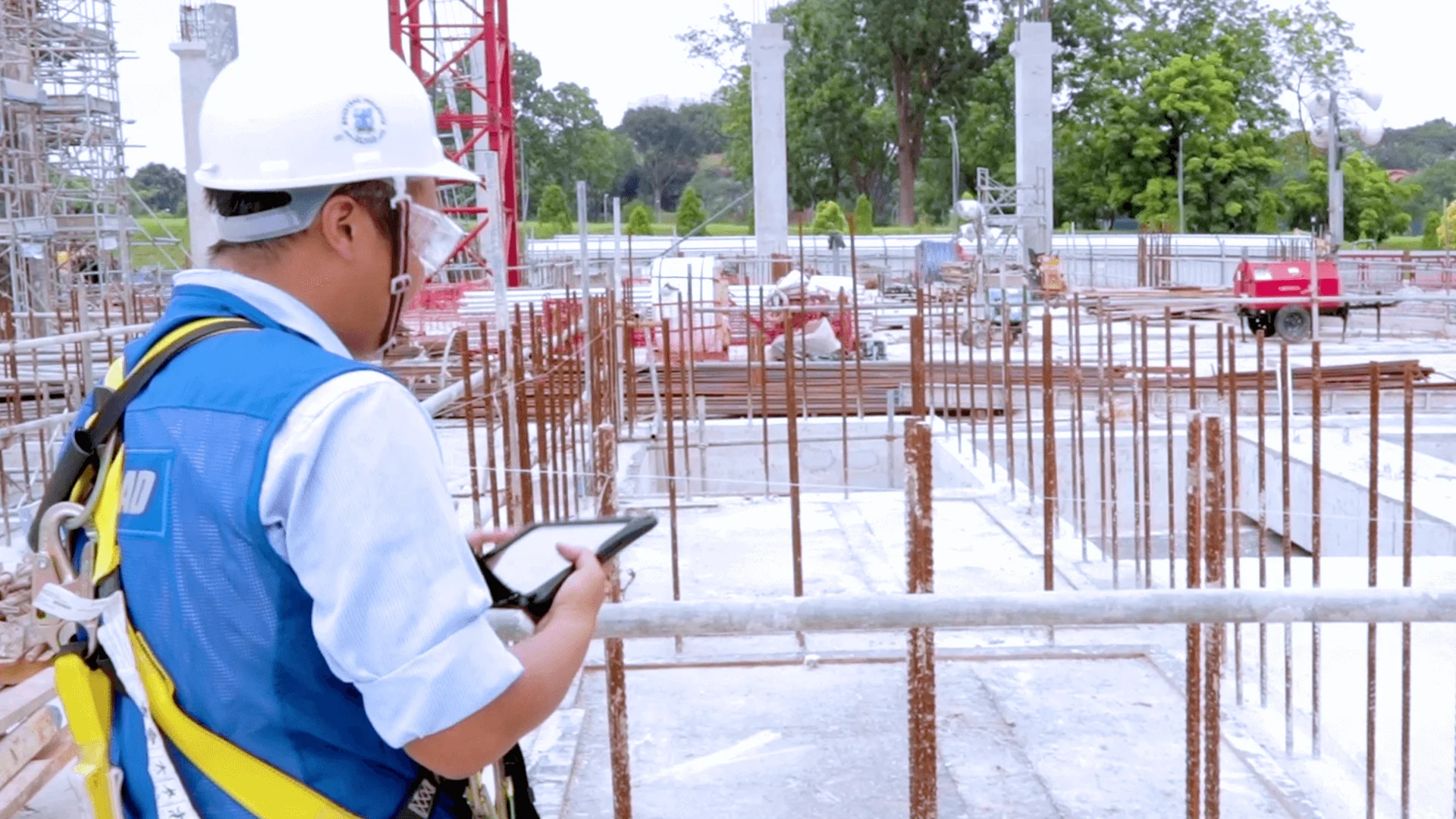

Digital tools are now widespread in the construction industry. From mobile forms to drones and sensors, construction teams are generating more field data than ever before. Collecting data, however, is only the first step. The real opportunity lies in using that information to make better decisions, reduce risk, and improve efficiency.
Artificial Intelligence (AI) is no longer a futuristic concept. It is already helping teams automate repetitive tasks, identify potential risks earlier, and extract useful insights from complex site data. This article explores how AI in construction works, the value it brings today, the requirements for success, and what the future may look like.

Why AI matters in construction
Construction teams operate in fast-moving environments where safety, quality, time, and cost pressures all compete at once. AI helps make sense of the data produced on site so teams can spot patterns, prioritise actions, and respond faster. Instead of replacing people, it strengthens decision-making with timely recommendations and automation.
What is AI and how does it apply to construction?
In simple terms, AI refers to technologies that enable machines to perform tasks that usually require human intelligence. In construction, three categories are especially relevant today:
- Large Language Models (LLMs): Understand and generate text. Useful for chatbots, summarising reports, drafting documents, and helping teams retrieve information quickly.
- Computer vision: Analyses images and video. Helpful for monitoring progress, identifying safety risks, and detecting quality issues.
- Machine learning (ML): Detects patterns in historical or live data to make predictions, such as delay risks, safety incidents, or equipment failures.
Comparison of AI technologies in construction
| Type of AI | Designed for | Strengths | Limitations |
|---|---|---|---|
| LLMs | Content creation, report review, chat assistance, document search | Fast to deploy, cost-effective, strong productivity gains for text-heavy workflows | Can hallucinate or produce inaccurate answers without validation |
| Video AI | Site monitoring, safety compliance, access control, visual inspections | Real-time visibility, non-intrusive visual monitoring, scalable oversight | Camera infrastructure can be costly, accuracy is not perfect, privacy must be managed carefully |
| Predictive models | Forecasting safety risks, delays, cost overruns, equipment failures, and quality issues | Strong decision support when trained on good data, useful for planning and prioritisation | Requires reliable datasets and ongoing review as site conditions evolve |
Trends in AI adoption
Recent research by the University of Melbourne highlights how quickly AI is becoming part of everyday work:
- In emerging economies, 72% of employees regularly use AI, compared with 49% in advanced economies.
- More than half of respondents report performance improvements from AI tools.
- At the same time, many users report mistakes and unsafe handling of confidential company information.
The lesson is clear: wider adoption must be matched by good governance, secure tools, and clear operating rules.
Key use cases of AI in construction management
1. Safety compliance and risk prediction
Construction sites are inherently risky environments, and ensuring safety compliance remains a top priority. AI already supports this through two powerful approaches: video analytics and predictive risk models.
- Video AI can analyse live CCTV or site footage to spot safety violations such as missing PPE or restricted-area access.
- Predictive analytics uses historical incident data to flag high-risk activities, teams, or locations before issues escalate.
Benefits: better compliance, faster intervention, and fewer incidents.
2. Quality control and compliance
Maintaining quality across complex projects is a constant challenge. AI helps identify defects earlier and makes documentation more consistent.
- Computer vision can scan photos or video to detect anomalies such as cracks, water damage, or surface defects.
- LLMs can summarise inspection findings and help standardise reports, reducing administrative effort.
Benefits: earlier defect detection, stronger documentation, and faster handover preparation.
3. Progress tracking and forecasting
AI offers new ways to measure progress and anticipate future delays.
- Computer vision and drone footage can be analysed to compare actual work completed against planned milestones.
- AI can assess site diaries, schedules, and daily reports to detect discrepancies and forecast likely schedule slips.
Benefits: faster reporting, earlier warnings, and better visibility across the project timeline.
4. Predictive maintenance and asset monitoring
Predictive maintenance helps prevent unplanned equipment failure that can halt progress and inflate costs. AI enables this by analysing sensor data from machinery to forecast failures before they happen.
- Systems can monitor temperature, vibration, or usage patterns in real time and trigger alerts when readings become abnormal.
- Teams can schedule servicing before failure disrupts productivity.
- Equipment life can be extended through earlier intervention.
Benefits: fewer unplanned breakdowns, better maintenance planning, and improved equipment ROI.
From safety and quality to scheduling and maintenance, AI is already proving its value across the construction lifecycle. The most effective platforms are the ones that integrate these capabilities into real workflows instead of treating AI as a standalone add-on.
What’s needed to make AI work on site?
AI offers enormous potential, but success depends on more than powerful algorithms. To unlock value in construction, organisations need the right operational foundations.
High-quality, structured data
- Use structured forms and digital workflows.
- Consolidate data from multiple sources.
- Ensure teams input data accurately and consistently.
AI is only as good as the data it learns from. Clean, timely, and consistent field information is the foundation of every useful model.
Seamless integration into workflows
- Embed AI into mobile apps, dashboards, and reports already used on site.
- Automate routine tasks without disrupting delivery teams.
- Avoid siloed solutions that create double entry or extra training overhead.
When AI feels like a natural extension of existing tools, adoption is faster and ROI is easier to prove.
User-friendly interfaces and training
- Use chat-based interfaces or guided experiences where appropriate.
- Provide clear explanations for AI recommendations.
- Keep interactions lightweight and mobile-friendly for site teams.
Field workers are construction experts, not data scientists. Practical UX matters as much as model performance.
Responsible governance and compliance
- Define clear rules for data collection, access, and retention.
- Use enterprise-grade security and compliance controls.
- Make sure AI-supported decisions remain transparent and auditable.
Construction data can include sensitive project, workforce, and video information. Responsible governance is essential.
Organisational confidence in AI
- Provide onboarding tailored to field users.
- Start with one or two clear use cases that demonstrate quick wins.
- Involve users early and use feedback to improve adoption.
- Communicate benefits clearly, from time savings to better safety outcomes.
Using AI in construction is not just a technical shift. It is also about trust, usability, and daily relevance on site.
Common myths and challenges
As AI gains traction on construction sites, it is still often misunderstood. Some myths slow adoption, while some real challenges must be managed carefully.
Myth 1: AI is only for large, high-tech projects
AI is now accessible to projects of many sizes. Cloud-based software, mobile apps, and configurable workflows mean companies do not need a massive IT budget to get started. In many cases, smaller teams can benefit the fastest from automation and clearer reporting.
Myth 2: We do not have enough data for AI to work
AI can deliver value with smaller, cleaner datasets than many teams expect. Structured inspections, daily site reports, forms, and equipment logs are already enough to start generating useful insights. As usage grows, the data foundation becomes stronger.
Myth 3: AI outputs cannot be trusted
Trust depends on the environment in which AI is deployed. When solutions are implemented with safeguards, audit trails, and human oversight, reliability improves significantly. The goal is not blind trust, but informed decision support.
The best results come from practical use cases, strong governance, and tools that fit naturally into day-to-day site operations.
The future of AI in construction
As these technologies mature and become more accessible, the industry is moving beyond isolated use cases toward connected and intelligent job sites.
AI, IoT, and BIM working together
- IoT sensors can collect real-time data such as temperature, equipment use, or worker location.
- AI can analyse this data to detect risks or optimise workflows.
- BIM can provide the spatial context needed to understand change, progress, and impact.
Together, these systems make it easier to plan, monitor, and react with greater precision.
AI copilots for field teams
- A foreman could ask an assistant for the day’s highest-priority safety issues.
- A project manager could receive automated summaries of progress and blockers.
- A quality engineer could review AI-assisted reports generated from drone or photo evidence.
These tools will not replace humans. They will support better decisions and free time for higher-value work.
Smarter scheduling and coordination
- Models will forecast efficient task sequences.
- Teams will receive more realistic schedules based on real constraints.
- Resource conflicts can be flagged before they affect delivery.
As AI handles more coordination in the background, site leaders can focus more on execution and risk management.
Ethical and transparent AI
- Users should understand how recommendations are produced.
- Outputs should remain explainable and auditable.
- Privacy and consent must be respected, especially when video is involved.
The future of AI in construction is not science fiction. It is a practical shift toward tools that help teams build faster, safer, and better.
Why now is the tipping point
The rise of AI on construction sites is happening now. Mobile apps, sensors, and digital workflows mean more site data is available than ever before. At the same time, cloud computing, open-source models, and ready-to-use software have lowered the barrier to adoption dramatically.
Early adopters are already seeing fewer incidents, higher quality, and stronger project control. AI in construction is no longer an experiment. The tools are ready, the business case is clearer, and the advantage increasingly belongs to teams that move early.
Explore related Novade solutions